



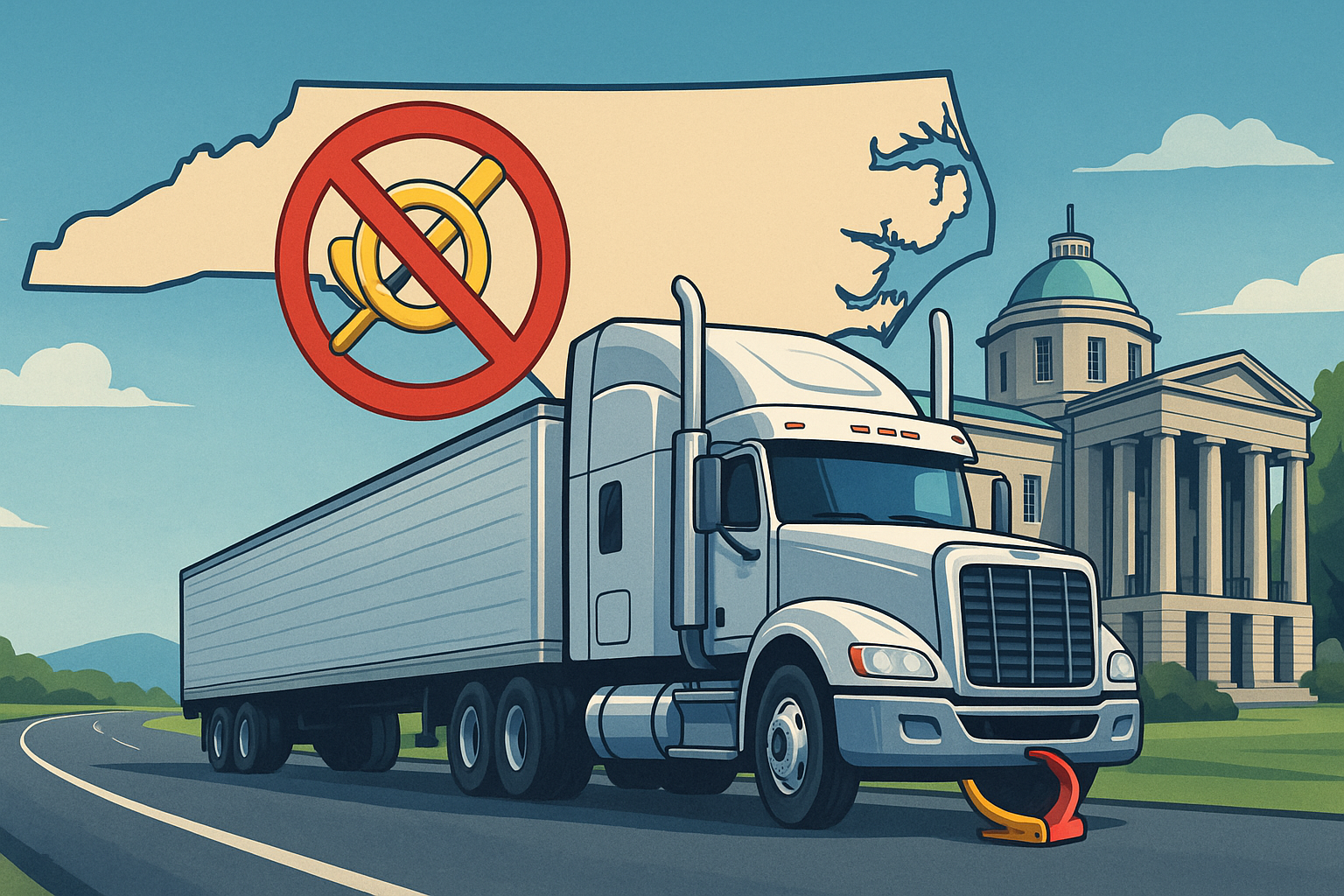
North Carolina bill would ban predatory towing practices
Insights on Combatting Predatory Towing in the Whole Country
As a state taking a pioneering step for the trucking industry, North Carolina has just passed the law prohibiting the booting of commercial trucks, signaling a strong position to other states across the nation.
This law, addressing the concerning issues of predatory towing practices, is a great victory for truck drivers, carriers, as well as for logistics companies that have been gazing for a long time at the merciless empty of warehouse space and seize threat tactics that affect security and profitability.
The enforcement of this law is an expression of the changing tides in the trucking industry, which is recognized by the forward-thinking commercial trucking company-driven Leadgamp, which stands firmly for advocacy and driver support. The law is proof of the ever-increasing demand for just and equal regulations, which is the reason it is more than just one New York state’s towing ban. The prohibition is the fundamental step toward national reform and provides essential notes for fighting predatory towing everywhere in the world.
Why North Carolina’s Booting Commercial Trucks Ban is Important
The commercial truck booting — the action of immobilizing trucks with clamps or boots — has for a long time been a topic that bears conflict between operators and private landlords. A lot of the time, the truck drivers who have to stop for the sake of taking a break or doing their logistics route, get boots or are towed within a few minutes, some of the times even in the presence of I signs that are not clear or that mislead them. They use these means of enforcement through subcontracted boaters who are the moneylenders for dealing with such “crimes’by sometimes taking out more than nationwide .
North Carolina’s initiative of banning the booting of commercial trucks is a considerable and historical move that explicitly protects the affected people from these unfair practices. Thanks to the new law, commercial trucks must no longer be immobilized for minor issues or during significant rest periods at all. Parking and violations disputes should now be addressed through courts or municipalities rather than private towing companies as was the case in the past.
For Leadgamp, which operates fleets all over the Southeast, this action is the beginning of relief for many drivers who were often singled out in urban loading zones or when delivering just-in-time. This gives them the opportunity to work normally, without fear of immobilizing their trucks for minor issues.

Outcomes for the Towing Sector
The enforcement of commercial vehicles has certainly not been a clean-cut area for the towing industry, instead, it has been a muddy field to be working on. In most of the states, landlords and contracted tow companies enjoyed their autonomy, with withering rules of their own, booting vehicles with no notice and demanding immediate payments for vehicle removal.
If it is the case that towing is crucial, especially in scenarios where there is true obstruction or safety violations, many representatives of the commercial truck sector — including those from every major truck driver recruiting company — have doubted if the authority over the years has been misused.
The ban on towing effectively forces a reexamination of this relationship by giving official status to the vital role which trucks have in the supply chain, apart from acknowledging the difficulties drivers experience on the road.
The ban is precedent-setting: it shows that through the state, regulations meant to serve both property owners and truckers equally are not only possible — they are necessary.
Important Points on How to Grapple With Predatory Towing for the Whole Country
This daring move that North Carolina made conveys various instructive points for other states that aim to tackle predatory towing:
- Set clear parameters
The regulations should indicate precisely where and when trucks can park, and this should be enforced in a fair manner. Inconspicuous signs or hidden protocols serves as a bad starting point for disputes. North Carolina’s statute requires clear signage and record-keeping to reduce the risk of malfeasance. - Restrict the power of private enforcers
Permitting individuals to act as enforcers can be not only misused but it can lead to failure. A successful model was the one that has the authority in a single place — either with municipal or state control — to which responsibility is attached. - Reasonable fee structures must be in place
Shameful towing charges weigh heavily on the pocket of small trucking companies and owner-operators. The setting of limits on fee charges, as well as the introduction of obligatory methods to find resolutions to disputes, are the steps North Carolina is trying out which will help bring about fair treatment. - Protect well-deserved rest and safety rights
Under the federal law of Hours of Service truck operators must make the brake time mandatory. Any actions that would unduly penalize the truck drivers for legal periods of rest are counterproductive, both for the drivers and public safety. Commercial truck booting during obligatory rests must be halted. - Take industry views in policy formulations
Entities such as Leadgamp which consist of fleets, drivers, and logistics people should be part of the discussion. Trucking industry companies have hands-on experiences and they can advice on where the abuses of towing occur and evidence on what reforms work.
Nationwide Team Efforts: Are Other States on Board?
By being one of the front liners, North Carolina sends the appropriate message to other freight centers across the country. Despite the incidentals that are hanging like a sword, states are setting out to amend their respective regulations with increased pressure exerted by drivers as well as trade associations.
Leadgamp is the one that has been on the forefront of this movement, teaming up with local partners and regulators to advocate for driver protections in pivotal metropolitan areas. The end goal is not absolute respectlessness but it is about reasonable, consistent regulations that focus on safety far better than revenue-based motivations.
Other jurisdictions are already being bombarded with truck regulations issues neither through lawsuits, petitions, and city council actions. North Carolina’s message proves that policy-wise, relying on the protection of commercial trucks from exploitation is not just a good solution but also a necessity for the supply chain’s strength.

What Trucking Companies Should Do Right Now
Even though the legislative changes need time, steps can be taken by commercial fleets to level off the situation right now:
- Make a Record of Each Incident
Drivers said they should photograph the booting or towing and Save the time stamp and contact information of those involved in such incidents. This will give the driver the chance to appeal if ever there will be a dispute. - Teach Drivers About Their Rights
A lot of the time the operators of the commercial vehicles are ignorant about their rights. Regular training of the drivers in a must is the program Leadgamp uses to make sure employees/chauffeurs have a clear understanding of their actions in case troubleshooting arises. - Work Together with Local Authorities
The carriers should establish good contacts with their government representatives in order to share the real-life experiences. The more well known the concern is the quicker will the change become. - Join Advocacy Groups
Work alongside the national coalitions that call for instating towing bans and the development of truck regulations regulation laws. Crossbreeding of action gives results.
Leadgamp’s Pathway to Safer Roads and Dealing Fairly
Leadgamp has had its eyes open to the fact that predatory towing not only affects the profits that we get but also leads to the unhappiness of our drivers. From wasted hours to the unjust fees that they have to pay, all these things add up. It is for this reason that we stand firmly with the relevant legislation like the new ban on the booting of commercial trucks that North Carolina has come up with – and we drive for similar pursuits around the country.
We believe in a logic system where truckers are honored for their duty in maintaining the wellbeing of America and not scolded for the valid stop by a rest break or delivery time. Leadgamp is happy and feels responsible to lead by example through designing and fostering a new balance in towing that is fair to all.
State by State
Although the North Carolina ban on towing is just a single victory, it is the first step, and real surgery requires that the nation be conscious, that there are common standards on the borders of each state, and that the commercial trucking sector speaks in unison.
Companies like Leadgamp , by standing up for their drivers, show that real change can be witnessed. The hope is that the states will investigate, that they will apply this efficient technique that they will then take direct actions such as passing commercial truck booting laws, thus, doing away with the exploitation as well as protecting property and the public.
Because every state that embarks on the mission of combating predatory towing gets us closer to establishing a uniform national standard — a standard that respects the laborious drivers who are the ones moving the goods from one side to the other.