


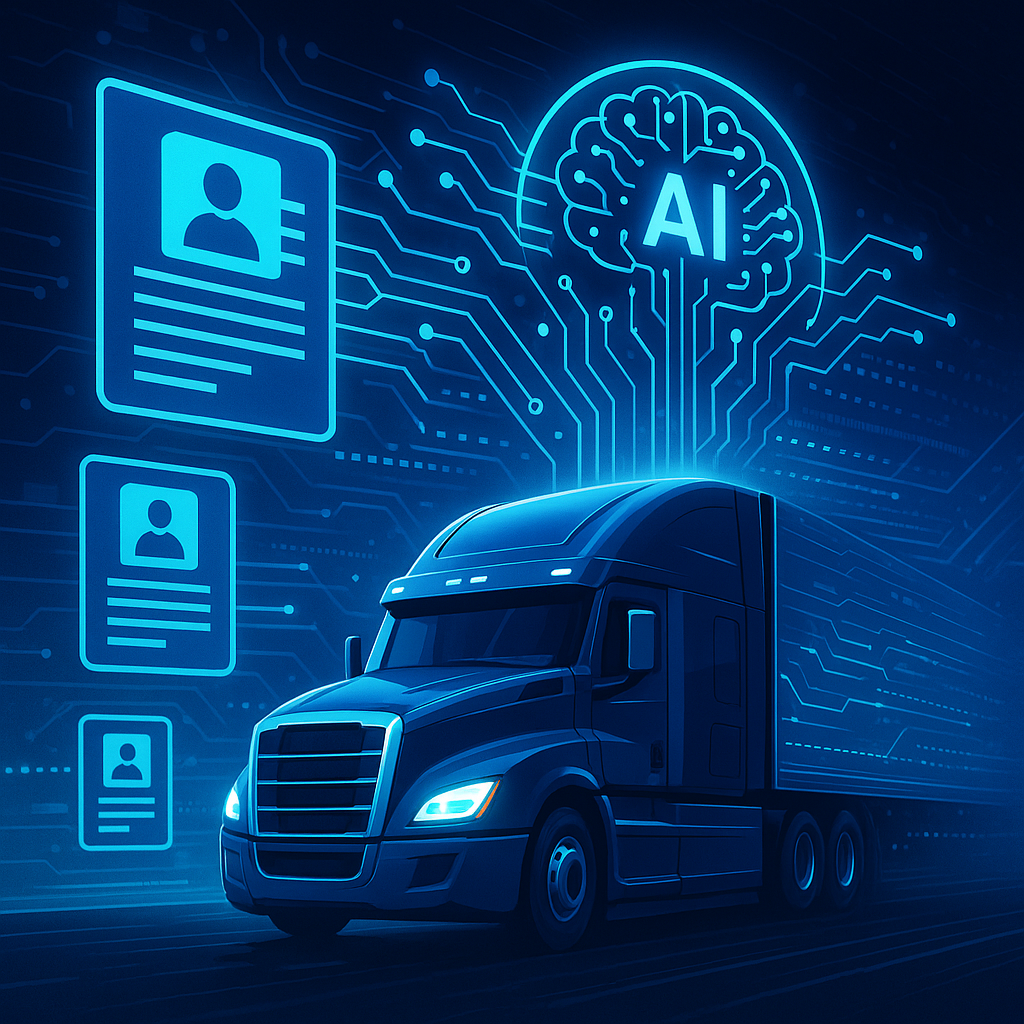
Attracting and retaining employees is a significant challenge in the trucking sector. Carriers are faced with the task of finding the most effective ways to attract and hire the best drivers when there is a high demand for transport services and a lack of qualified drivers. The best solution to the problem is the adoption of AI and automation in the truck driver recruitment process. Consequently, you will be able to automate some hen some of the processes that are involved in recruiting drivers, enhance the experiences of the candidates, and obtain a competitive advantage. This article discusses important advances in the technology and the different applications for the recruitment process — from the use of chatbots to predictive analytics. You will be presented with the processes that can help you to hire the right talent, increase efficiency, and improve every step of the recruitment journey. Be it a small fleet or a big carrier, these tips will help you to set up a more intelligent, quicker, and reliable driver pipeline.
Smart Sourcing using AI-Driven Platforms
Sourcing starts with visibility. While traditional job boards and classifieds still do play a role, the AI-powered sourcing platforms go even further than that. These platforms are capable of scanning resumes and profiles across several channels such as LinkedIn, niche trucker forums, and internal databases to find candidates that suit your criteria. Doing that means natural language processing is the first priority in these algorithms parsing testaments, skills, and certificates. Consequently, the best prospects are given in a couple of minutes instead of the previously predicted days.
- Skill Matching: AI algorithms compare such keywords as “CDL Class A” or “hazmat endorsement” with your job requirements and give rates to the candidates according to the relevance.
- Broader Reach: Automated sourcing taps into passive candidates who aren’t actively looking for a new job, but who fit your profile.
- Continuous Learning: The more you hire, the smarter the system becomes, thus continuously refining its recommendations.
AI-driven sourcing technology allows fleets to make the recruitment process significantly faster by reducing time-to-hire by 50%. In the case of Trucking Talent, we have parceiro agreements with these platforms, which have resulted in a 30% increase in the initial candidate pool, therefore, allowing for better outreach by recruiters.
Instant Engagement through Automated Outreach
As soon as you have obtained a list with qualified candidates, the next assignment is to ensure that you make a speedy follow-up. Recent studies confirm that the timing of the first communication after the application received is the most crucial factor for a high candidate engagement rate (i.e. this will be achieved only if people get in touch after a few minutes). Automation solutions allow this by combining AI with voice and messaging channels:
| Tool | Key Features | Stage | Benefit |
| Virtual Recruiter (Lead Assist) | AI-driven calls and texts, real-time follow-up | Outreach | Reduces drop-off, keeps momentum |
| AI Chatbots (e.g., Paradox Olivia) | 24/7 Q&A, pre-screening, interview scheduling | Screening | Engages drivers instantly |
| AI Voice Agents (Double Nickel model) | Automated call/text sequences, personalized scripts | Outreach | Ensures no candidate slips away |
| Intelligent Email Sequencers | Personalized email cadences, open-rate optimization | Engagement | Improves response rates |
Automated outreach tools enable the recruitment office to send mass messages, such as application receipts, chatbot messages about hours of service compliance, or voice bots answering the frequently asked questions associated with licensing. This “always-on” mode of operation lets the recruiters concentrate on personal communication with those promising candidates only.
Intelligent Screening and Assessment
Screening is the area where speed and quality go hand in hand. Screening channels driven by AI, for instance, use a combination of resume parsing, video assessments, and behavioral analytics that enable a more objective evaluation of the applicants:
- Automated Resume Parsing: The system automatically extracts the core data like hours spent driving, accident history, endorsements, and the count of compliance red flags.
- Video Interview Analysis: In case the applicants record the video answers, the AI can recognize the clarity, engagement, and authenticity of the speech without the scheduling of logistics.
- Behavioral Matching: The system makes use of machine learning algorithms to weigh the candidate’s profile against your best employees which are: customer feedback, tenure, and safety record.
Using automation features such as resume review can alleviate the fleets’ workload with up to 70% of manual input. The benefits of this technology come from improving interview quality, as fleets can concentrate on the most valuable candidates and time for manual reviews and interviews is also saved. In addition, this objective scoring mechanism reduces the human factors that cause prejudice and leads to the inclusion of a more diverse and trustworthy driver group.
Streamlining Interview Scheduling and Follow-Up
Arranging interviews is one of the most time-consuming activities, particularly when juggling drivers’ routes and availability. Automation platforms help by integrating with calendars and SMS’s to:
- Offer Multiple Slots: Selected candidates text or email links to choose slots.
- Send Reminders: Automated reminders cut no-show rates by as much as 60%.
- Capture Reschedules: If drivers can’t make the appointment, AI reschedules without human intervention.
These scheduling bots not only eradicate undesired back-and-forth emails and phone calls but they also shorten time and increase candidates’ satisfaction during the interview process. The quick recruitment process, in turn, is a sign of courtesy toward the driver in terms of time that has been spent, thus positively affecting the brand image in the logistics market.

Enhancing Retention with Predictive Analytics
The recruitment process is not over when you make a hiring decision. Curbing the turnovers includes retention, and this is a field where AI has made a considerable impact thanks to predictive analytics.
- Success Modeling: The software examines onboarding feedback, route performance, and safety records to figure out which drivers are at risks from the early stage.
- Tailored Engagement: Automated check-ins and training recommendations based on individual performance trends.
- Compliance Alerts: The system enables real-time alerts when certifications or logs of hours of service need renewal, cutting down compliance risks.
Fleets that apply predictive analytics observe an increase in the short-term retention rate from 20 to 25%. You, on the other hand, can initiate the loyalty of drivers by your proactive action and dealing with their needs beforehand as well as actively preventing issues that the drivers would have to face.
Best Practices for Implementing AI and Automation
Bringing new technology on board requires a balanced plan. Follow these best practices to maximize ROI:
- Pilot Small, Scale Fast
- Begin with one component (e.g., chatbots) before the rollout of a full suite.
- Measure response time, candidate drop-off, and time-to-hire as metrics.
- Begin with one component (e.g., chatbots) before the rollout of a full suite.
- Integrate with Existing Systems
- Smooth communication of your ATS, scheduling tools, and HRIS is a must.
- Pick platforms with open APIs to prevent siloed data.
- Smooth communication of your ATS, scheduling tools, and HRIS is a must.
- Train Your Team
- Run hands-on workshops for the recruiters to trust and understand AI outputs.
- Make “AI champions” who can troubleshoot and gather feedback.
- Run hands-on workshops for the recruiters to trust and understand AI outputs.
- Maintain a Human Touch
- Use automation for simple tasks and save the human conversations for the relationship building.
- Use outreach templates with dynamic fields (like candidate name, route preference) when personalizing.
- Use automation for simple tasks and save the human conversations for the relationship building.
- Measure Continuously
- Set clear KPIs: cost-per-hire, time-to-fill, candidate satisfaction.
- Employ real-time dashboards that are up to date, which will let you to take quick counter-actions as needed.
- Set clear KPIs: cost-per-hire, time-to-fill, candidate satisfaction.
The use of AI and automation throughout the recruitment journey is not only a benefit to small or medium-sized fleets but also a pathway to become an embodiment of an efficient process and a recreator of an excellent experience for both candidates and recruiters through a trusted platform.
Conclusion
In a tough market replete with limited margins and cut-throat competition, using AI and automation in truck driver recruitment is no longer a choice, but a compulsion. With the application starting from AI-driven sourcing and chatbots that respond to candidate inquiries to predictive analytics that sustain the ecosystem, these tools are fully able to revolutionize the whole recruitment and hiring process. For fleets, which would like to throw themselves into the spotlight, the time is to act. With digitalization, you can augment your processes and keep your trucks rolling with high-quality drivers fully equipped to tackle contemporary logistic challenges.
“At Trucking Talent, we combine the latest innovations in-AI with personal service to successfully drive the process of recruitment in the contemporary dynamic market.”